
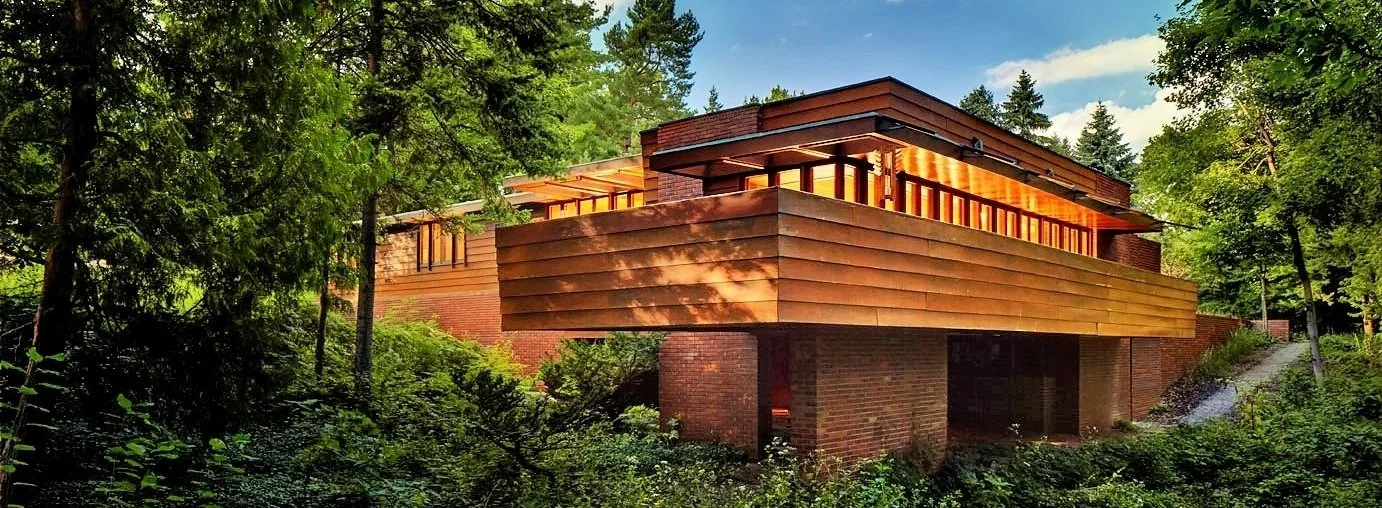
Affleck House. © Frank Llyod Wright Foundation.
No American architect has ever reached the heights of fame that Frank Lloyd Wright has—and it is unlikely that any other American architect ever will. Not only does Wright prompt a seemingly endless flood of books and articles dedicated to his singular vision, but his buildings remain tourist meccas for aesthetic devotees. Fallingwater (Mill Run, Pennsylvania) and the Guggenheim Museum (New York City), in particular attract pilgrims from across the globe.
His enduring popularity long ago spilled over into common culture. Wright-inspired kitsch—everything from cocktail glasses to tea sets to earrings to jigsaw puzzles and cufflinks—is available online or at museum gift shops across the country. There is even a support group for those who dream of owning a home designed by Wright. Finally, Wright remains the only architect featured as the subject of a Ken Burns PBS documentary (for comparison, two boxers have gotten the Burns treatment: Jack Johnson and Muhmmad Ali).
So exalted is Wright for his uncompromising artistry, that it may come as a surprise to some that he spent years conceptualizing and designing homes for the middle-class. He called these houses, which began appearing in the late 1930s, Usonians, and they remind us that affordable architecture is under no obligation to be merely pragmatic at best or unsightly at worst. (Wright did not coin the term Usonian, as is commonly believed. For Wright, Usonian meant distinctly of the United States, removed from Old World styles and associations, and, ultimately, devoid of the pastiche, patchwork outlook of so much American architecture.) And, despite his outsize egotism, Wright firmly believed in the democratizing notion that distinguished architecture should be within reach of ordinary Americans. In fact, Wright had experimented with affordable housing years earlier, with his American Built Systems, prefabricated kit homes that would reduce expenses by standardizing designs and reducing manufacturing and transportation costs.
As the Great Depression dragged on (with the third-worst recession of the 20th century arriving in May 1937), affordable design became imperative. In 1937, Wright completed his first Usonian house: the Jacobs Residence in Madison, Wisconsin, featuring brick, board-and-batten walls (made from Ponderosa pine and redwood), casement windows, and clerestories. At $5,500 (including the design fee), the Jacobs residence may not have been low-income housing, but it was accessible to tens of thousands of middle-class Americans—even during a sustained economic downturn. Today, that $5,500 price tag translates to $130,000, about what the average mobile home costs.
Wright eventually designed hundreds of Usonian homes, and sixty of them were built from 1937 until his death in 1959.
Usonian homes are distinguished by several features: open floor plans, flat roofs, an L-shaped layout, radiant heating, exaggerated overhangs (for keeping interiors cool during summer months), built-in furniture (to maximize space), natural materials (often locally sourced), abundant daylighting via picture windows, and carports. Wright also limited ornamentation to the manipulation of the materials themselves, such as carving niches in the brickwork, trellising wood, and breaking up wall windows with vertical and horizontal elements. Many of these Usonian concepts had a powerful influence on developers and eventually circulated across suburban America through the planned communities of Alfred Levitt and the evolution of the Ranch Style of the 1950s.
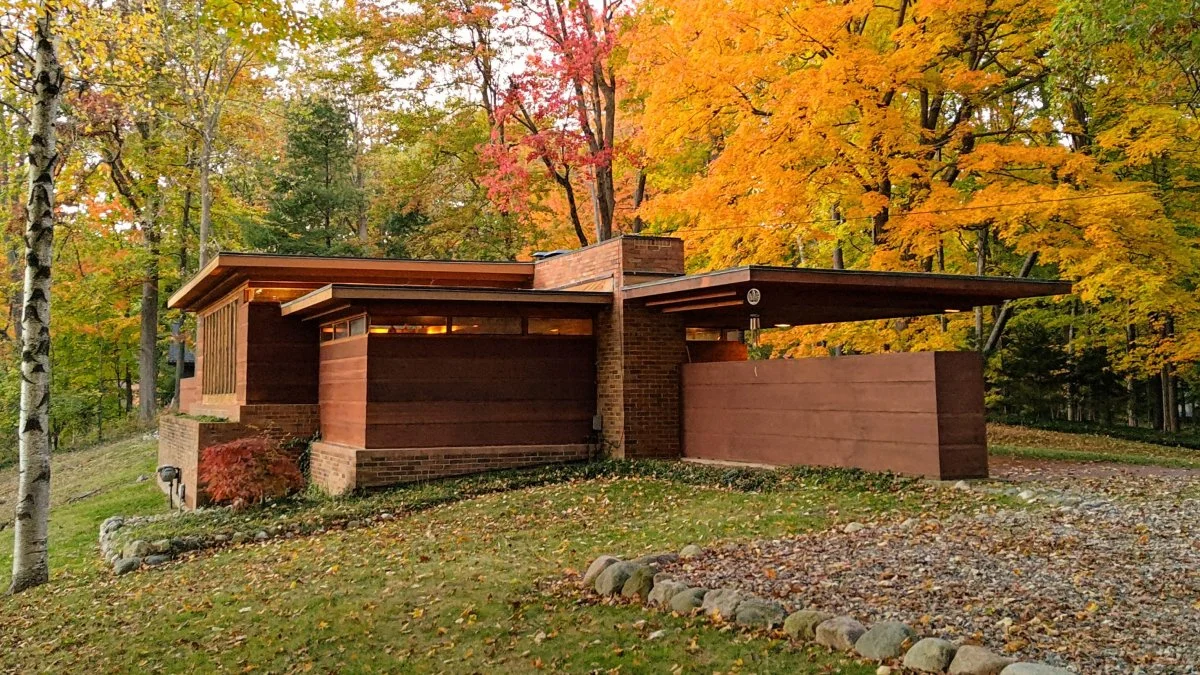
Goetsch-Winckler House. © Frank Llyod Wright Foundation.
For the interior layout, Wright imposed a modular grid design (often echoed in the patterns of the concrete flooring), giving each Usonian home an organizing principle. At the center of these modular designs often stood the fireplace, now a symbolic nucleus, while the large living room stressed community and interaction, emphasizing the livability and psychological aspects of day-to-day activities.
Wright waged an aesthetic war against the clutter, compartments, and claustrophobic layouts of Victorian architecture, pioneering the use of open plans and, in the process, reimagining the dynamics of the domestic space. “Living within a house wherein everything is genuine and harmonious,” he once wrote, “a new sense of freedom gives one a new sense of life—as contrasted with the usual existence in the house indiscriminately planned and where life is contained within a series of confining boxes, all put within the general box.” His disdain for the commonplace box—the dominant configuration of American interiors—led Wright to pioneer the open floor plan.
Ever the innovator, Wright designed concrete slab floors with radiant heating systems beneath them, allowing not only for the elimination of excess walls (and radiators, which Wright despised) but enabling maximum daylight throughout the house.
By using local materials whenever possible, Wright reduced construction costs while adhering to his philosophy of a home in harmony with its surroundings. This combination of creativity and thrift led Wright back to his modular experiments of the 1920s. “Wright developed a whole system of building for the Usonians. With the Prairies, he was doing really interesting things, but he was generally using fairly traditional building systems: stud walls, stucco, things like that,” said John Waters, preservation programs manager at the Frank Lloyd Wright Building Conservancy. “With the Usonians, he really developed a whole building system. Typically, in what we think of as the classic Usonians Pre-World War II, the walls are made up of a sandwich structure that consists of horizontal boards on the interior and the exterior and then a central layer which is either vertical planks or plywood. He saw this as a more efficient way of building.”
Whatever one can say about Usonians one can never say that they are non-descript, unlike so much contemporary affordable housing. Usonian houses are marvels of texture, geometry, warmth, and lyricism, evoking the spirit of their surroundings and shaping everyday experiences. The creativity and ingenuity behind Usonians offer us a glimpse of possibilities for the future even after nearly a century.