
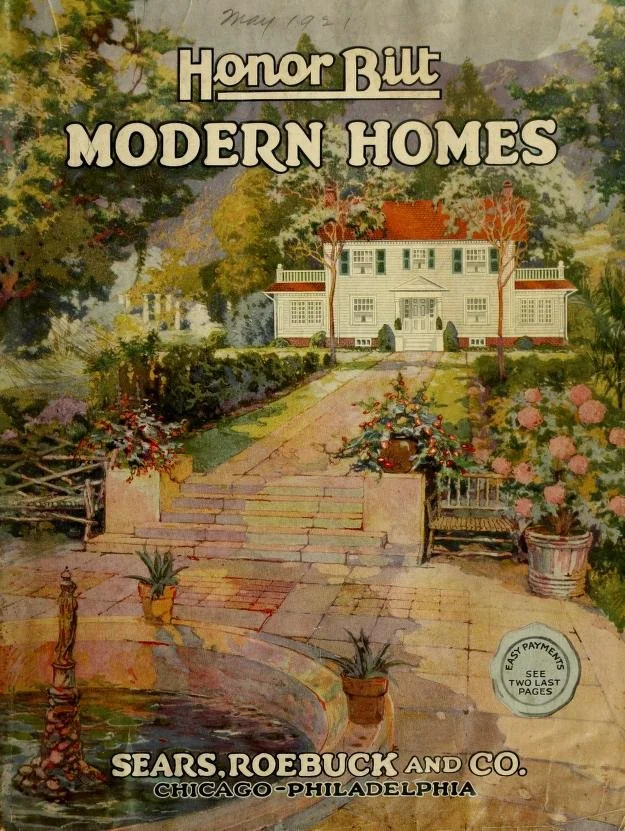
Honor bilt Modern Homes. © Sears, Roebuck and Company, Chicago.
It may come as a surprise to some that more than 100,000 kit homes—precut and fitted houses ready for assembly and shipped to clients–-were sold and built in the United States between the early 1900s and the 1940s. A typical Sears kit home, for example, had thousands of parts—everything from nails, to doorknobs, to millwork, to hinges—and could be assembled far quicker than the average standard house. (While Sears is the most famous brand name associated with kit homes, several other companies manufactured them as well, including Gordon-Van Tine, Aladdin, Montogomery Ward, and Fullerton.)
These mail-order homes, which suggest the add-to-cart convenience of Amazon.com, were made possible by the advancement of the Industrial Revolution and the development and expansion of the continental railroad system in the 1860s, which allowed oversized freight to be transported across the country. But kit homes really boomed after World War I, when a shortage of building materials eased and when returning veterans joined the housing market. Kit homes brought low-cost housing to tens of thousands of American dreamers.
Given the substantial costs of construction today, it is worth noting how kit homes were affordable for lower-and-middle class homebuyers. Rebecca L. Hunter, in her book Mail-Order Homes: Sears Homes and Other Kit Houses, outlines the economic particulars: “Prices shown in catalogs typically included only the building materials; the cost of the finished house, including the materials, lot, foundation, and construction labor was usually at least double the catalog price. Prices for Sears materials ranged from $146.25 in 1911 for a two-room cottage to $9,990 in 1920 for a ten-room, two-and-a-half-story design.” Factoring inflation into the home-kit formula highlights just how affordable these DIY homes really were. That 10-room house retailing for $9,990 during the Jazz Age now equates to a price tag of roughly $167,000—a bargain in 2025.
One reason mail-order houses were so cheap is that their production was (essentially) vertically integrated: design, engineering, manufacturing, and transport were often handled in-house by the company, with outsourcing minimized. To keep their costs low, Sears purchased and operated its own factories, plants, and lumber yards to avoid subcontracting. Once delivered, a kit house was ready for assembly—its blueprints and thousands of meticulously packed parts, like a large-scale Ikea project. Only construction remained. At that point, a buyer would either risk assembling the house by themselves (along with some friends and family), or they would hire a local builder.
Honor bilt Modern Homes. © Sears, Roebuck and Company, Chicago.
Sears kit homes were distinguished by their use of quality materials (including Southern yellow pine and cypress) and as time went on they offered an aesthetic experience unmatched by current budget housing. What began as generic single-story residences soon developed into a broad range of models, with Sears eventually offering nearly 450 styles to choose from. Although most were based on the popular architectural fads of the day, several of the Modern Homes series borrowed from the Arts and Crafts movement as well as from historical styles such as Tudor, Cape Cod, and Dutch Colonial, to go along with the standard American Foursquare. Even Frank Lloyd Wright designed several precut homes for his ambitious if short-lived American Built-Systems venture, which produced mail-order kits based on his Usonian theories. In fact, a few Sears kit homes were modeled on some of the revolutionary Prairie Style designs that Wright (inspired, in part, by Louis Sullivan) pioneered in the early 1900s.
Unlike so much new construction, the Sears models adhered closely to their inspirations. Today, as exemplified by the McMansion craze of the last forty years, many popular suburban homes are a hodgepodge of existing styles (including classical ones) thrown together without aesthetic rhyme or reason. The typical McMansion is a mismatched patchwork designed without regard to scale, taste, or cohesion, and, more often than not, they are planned without the input of an architect.
Honor bilt Modern Homes. © Sears, Roebuck and Company, Chicago.
Until recently, prefabricated and modular housing had long been considered déclassé, sparking images of vinyl siding or, worse, the fragile and often flammable trailer homes that became popular in the 1970s, before stringent regulatory codes were applied to them. Due to the housing crisis and skyrocketing costs, trailer homes have seen a dramatic spike in sales recently. And what are now called “factory-built homes” have also exploded in popularity, with even Habitat for Humanity building them as an alternative to overpriced construction materials. But contemporary kit housing has lagged, possibly because it is largely pragmatic: designed for sustainability, economic viability (for the manufacturer), or ease of shipping, with an emphasis on a limited footprint. For example, Reframe Systems, based out of Massachusetts, focuses on net-zero homes, while EFFEKT Architects in Denmark experimented with a flat-pack system for its Urban Village Project.
Despite these specializations, and despite the current affordable housing shortage, kit homes are no more an option than they have been since the early 1940s, when Sears finally dissolved its Modern Homes department. This is reflected by the fate of Katerra, a Silicon Valley start-up which specialized in modular design, which went bankrupt a few years after its founding in 2015.
What the history of Sears kit houses reveals vis-à-vis contemporary architecture is a general loss of aesthetic standards for smaller-scale projects and, especially, construction standards. Sears homes were sturdy and if they did not necessarily stand out as modernist masterpieces, they at least retained a unity of design and were vastly superior to the McMansion trend that has produced thousands of tacky, cheap, and ill-conceived structures. Similarly, the desperate need for housing does not–and perhaps never will—galvanize the market. At one time, however, the needs of a growing middle-class and the corporate interests overlapped, creating what was colloquially known as “the American dream in a box.”
As technology advances and composite materials such as mass timber improve, producing affordable kit houses that are elegant and durable remains a tantalizing possibility, one whose time has come again.